Why Every Night Splint You've Ever Tried Failed You — And It Has Nothing to Do With Your Foot
The 2023 Physical Therapy Guidelines recommend night splints for first-step morning pain. So why are the majority of people who try them still hobbling to the bathroom? A physical therapist finally explains what the packaging never tells you.
If you've ever woken up at 2 AM, yanked a rigid boot off your leg in frustration, and thrown it to the floor — I need you to hear something first.
You didn't fail your night splint. Your night splint failed you.

And if you've spent months dreading those first ten steps to the bathroom every morning — gripping the nightstand, walking on the outer edges of your feet, waiting for the stabbing to ease — you are not alone. And this is not permanent.

One of my patients described it perfectly: "Getting outta bed should be a five-minute process."
She was right. It shouldn't be. But for her, it was. For another patient of mine: "Moments when the pain brought me to tears." For another: "It's hard for those around us to fully grasp just how crippling this can be."

Here's what most people never get told: your worst morning pain doesn't start in the morning. It starts while you sleep. Your foot drops into a pointed, downward position every night. For eight hours, the tissue along your arch locks into its shortest, tightest shape. Then you stand up — and your full bodyweight yanks that cold, stiffened structure under full load. That's what the first step is. Every single morning.
My name is Rachel Hartman. I've been a licensed physical therapist specializing in foot and lower extremity care for over a decade. I've worked with nurses who've been forced off their feet mid-shift. Warehouse workers who have to go home by 2 PM because they can no longer stand. Women in their fifties who've quietly started planning their whole day around their pain — canceling walks, skipping the gym, sitting out from things they love.

And in that time, I've watched the same cycle play out hundreds of times: diagnosis, night splint recommendation, abandoned boot in the back of the closet within two weeks. Back to square one, convinced: "I guess they just don't work for me."
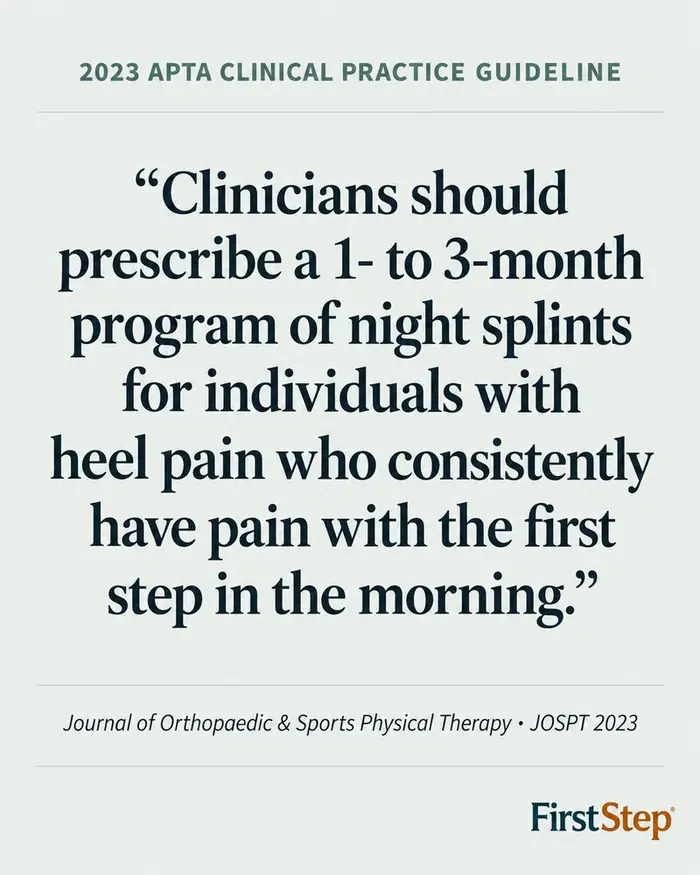
But the clinical guidance hasn't changed. The 2023 Clinical Practice Guideline from the American Physical Therapy Association is clear: clinicians should prescribe a 1-to-3-month program of night splints for patients with consistent first-step morning pain. Not "may consider." Should.
So why are so many people still hobbling to the bathroom every morning?
It isn't the concept. It isn't the condition. It's the device.
If you've already tried a night splint — once, twice, or three times — and given up on it, you're not the exception. You're the pattern.
Almost everyone who abandons a night splint assumes the concept doesn't work for them. Almost none of them stop to ask whether the device itself was ever designed to stay on through a full night of real sleep.
There's a reason so many podiatrists quietly know their patients won't actually wear what they hand them. I'll explain exactly why — and what that means for you.
What's Actually Happening to Your Foot While You Sleep
Picture your first ten steps tomorrow morning. Same alarm. Same swing of your legs over the side of the bed. Same floor. That moment — right there — is decided tonight. By what your foot does for the next eight hours.
Right now, if you're not wearing a night splint, here's what will happen: your foot will relax into a dropped, pointed position while you sleep. Your plantar fascia — the thick band of tissue running along the bottom of your foot — will slowly lock into its shortest, tightest shape. Like a rubber band that's been left loose in a cold room all night.
Then you stand up. Your full bodyweight loads through your heel. And in an instant, that cold, tight tissue is forced to stretch under full load. That's the stab you feel. That's why the first few steps are always the worst. That's why it eases once you've been walking for a few minutes — the tissue gradually loosens as it warms up.
"Your worst morning pain isn't caused by what happens when you wake up. It's caused by what happens during the eight hours before you do."
This is a predictable, mechanical event. The same event, every morning. Which means: if you can change what your foot does for those eight hours, you can change what that first step feels like.
This is the whole logic behind night splints. Keep the foot in a gentle, neutral position while you sleep — and the fascia wakes up elongated, not contracted. The first step starts from a better position. It doesn't have to snap from its shortest shape under full bodyweight.
The guidelines support this. The research supports this. Thousands of patients who've made it work can confirm it. So why do most people who try a night splint give up within two weeks?
Because of three specific mistakes. And the first one starts before they ever put a splint on.
Treating a Nighttime Problem With Daytime Solutions
When most people get a plantar fasciitis diagnosis, here's what they do. They start stretching every morning. They invest in orthotics at $300 to $800. They go to physical therapy. They try a cortisone injection — which works for about four months before the pain comes back.
None of these are wrong. Calf stretching has real evidence behind it. Physical therapy helps. Good footwear matters. I recommend all of them.
But every one of them has something in common: they address your foot during the hours it's awake. Not during the eight hours when the morning's pain is being set up.
A cortisone shot does nothing while you're asleep. Custom orthotics do nothing while you're in bed. Even the best pre-stand calf stretch is asking a cold, stiff tissue to lengthen against resistance at the exact moment of maximum vulnerability — and it requires memory, discipline, and correct form at the moment you're least capable of any of them.
Hard to do when you have to pee in the morning.
That's exactly right. The pre-stand stretch is clinically sound — it genuinely reduces the load on the fascia at that first step. But it needs you to remember it, do it correctly, and hold it for 30 seconds before your feet touch the floor, while you're half-asleep and urgently needing the bathroom.
The eight-hour window — while you sleep — gets almost no clinical attention. Except in one specific recommendation. Which brings us to the second mistake, and the one I hear about most often.
Using a Device Engineered for a Clinic — Not for a Real Bed
The standard posterior boot is the dominant design on the market. Over a thousand product listings. Hundreds of thousands of reviews. Recommended in clinical guidelines and printed on discharge paperwork from podiatry practices across the country.
And in my own practice — as in published research on this — the majority of patients who try one stop wearing it within the first two weeks.
Not because the concept is wrong. Because they cannot sleep in it.
Here's how it goes — and if you've been through this, you'll recognize every step of it:
I frequently found myself waking up in frustration and quickly taking them off.
The boot 'grabs' the top coverings and pulls them off the bed.
Worked great for the first few weeks. Then the velcro stopped sticking. Third one I've ordered. Same result.
Something usually reserved for immobile 80-year-olds.
These aren't edge cases. They are the dominant themes in virtually every one-star review across every major night splint brand on the market.
And here's the part that rarely gets said out loud: many podiatrists already know this. One clinic wrote publicly: "The 'best' splint on paper is completely worthless if it wakes you up at 2 AM." Another clinician admitted he "often refrains from recommending them since many people find them difficult to endure."
"The problem isn't the concept of overnight positioning. The problem is a design that makes overnight positioning impossible to maintain."
No device that wakes you up at 2 AM can do its job by morning. That's not a patient problem. That's a design problem.

And if you're keeping count: most patients who come to me have already tried two or three of these boots — at $19 to $30 each. The "cheap" option has already cost them $50 to $90. For devices sitting in a closet.
Expecting Night One to Feel Like Night Thirty
This is the quiet one. It's the mistake that costs even people who find a device they can tolerate.
Here's how it goes: you find something that isn't immediately awful. You wear it the first night. It's uncomfortable — not painful, just strange. You feel it every time you roll over. You sleep worse than usual. In the morning, your heel still hurts. So you conclude: this one doesn't work either.
What nobody told you — and what almost no packaging or instruction sheet ever explains — is that this is exactly what Night 1 is supposed to feel like.
When your body isn't used to wearing something to bed, it stays alert. That's not a device problem. It's an adjustment period. Your brain flags anything new as something to monitor — and monitoring costs sleep depth. The same thing happens with a new pillow. A new mattress. Even a new sleeping position.
With a night splint, this adjustment window is typically five to seven nights. People who push through it — with a device that's actually comfortable enough to make pushing through possible — hit a turning point around Night 6 or 7. They stop noticing it. Their body has filed it as normal. And by then, the fascia has had its first full week of overnight elongation.
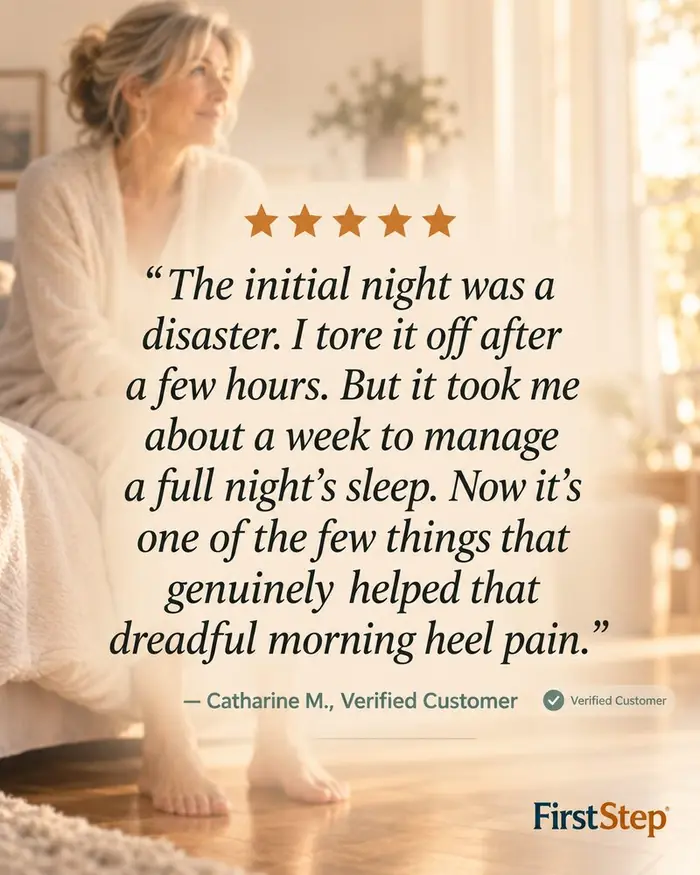
The initial night was a disaster — I tore it off while sleeping after only a few hours. But it took me around a week to manage a full night's sleep. Now it's one of the few solutions that genuinely alleviated that dreadful heel pain in the mornings.
That's not an outlier. That's the pattern. The clinical success stories almost all share it. The failures almost always involve giving up before the window closed.
The splint didn't fail. Night 1 failed. And those are not the same thing.
- Your worst heel pain is your first steps in the morning — and it eases once you've been moving for a few minutes
- You've tried at least one night splint and stopped wearing it within two weeks
- You've bought two or more Amazon splints — the velcro gave out, it slipped, or you simply couldn't sleep in it
- Your toes went numb, the boot snagged your blankets, or you woke your partner ripping it off at 2 AM
- A podiatrist or PT recommended a night splint, but you couldn't make it through a full night in the one they handed you
- You've told yourself: "I guess night splints just don't work for me"
If you checked two or three of those — night splints haven't failed you. The specific device has. And that is a meaningful difference.
So What Does a Night Splint Built Around All Three Failure Points Actually Look Like?
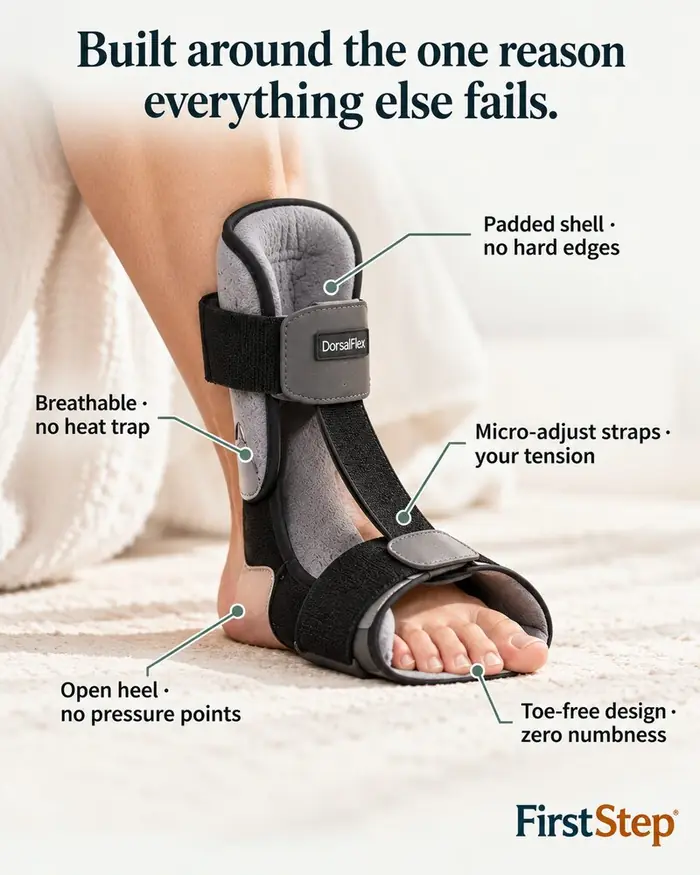
The design that finally changed this is called DorsalFlex. And the first thing I want you to know is what it isn't.

It is not a posterior shell. There is no rigid plastic casing wrapping around the back of your calf. No structure pressing into your Achilles overnight. No enclosed heel cup trapping heat. No toe cage. No hook-and-loop fastener surface on the outside that can catch a bedsheet.
What it is: an anterior dorsal splint. The support structure sits along the front of the shin and the top of the foot — leaving the heel, sole, and all five toes completely open.
Front of the shin, not back of the calf. That single design difference is what makes sleeping in it a realistic proposition.
60-day trial · Free shipping · FSA/HSA eligible
Why Each Design Choice Fixes a Specific Failure
Every one of those design choices exists specifically because of a documented failure mode in the standard posterior boot. This isn't a newer version of the same thing. It's a different engineering answer to the same clinical question.
The Protocol: What the First Eight Weeks Look Like
One thing I give every patient before they start a night splint program is a written protocol. Because wearing it — consistently, through the full adjustment period — is the single variable that determines whether it works. Not the design alone. Whether they can actually wear it all night.
If I skip wearing it, I definitely feel the discomfort the following day.
That's not a limitation. That's the device working.
Here's what I tell every patient before they start: follow the protocol. Wear it for the full first two weeks, even if Night 1 feels like a failure. Make it two months before you decide anything.
That's exactly why the trial is 60 days — not 30. Thirty days gets you through the adjustment period and into the early part of Phase 2. Sixty days gets you through the full morning-shift window. If DorsalFlex is going to work for you, you'll know by then.
If it doesn't — return it. Full refund. No questions. No restocking fee. No time limit. The trial is designed around the protocol. Not the other way around.
A Few Things Worth Knowing Before You Order
-
I'm a side sleeper. Will this actually work for me?The DorsalFlex works much better for side sleepers than the standard boot. There's nothing pressing into your calf. Nothing locking your leg into one position. You can roll over without waking up to readjust. That said, any new wearable takes a few nights to adjust to — which is exactly why Phase 1 is built the way it is.
-
What about bathroom trips in the middle of the night?
The quick-release buckles let you remove and replace it in under 15 seconds, in the dark, without waking anyone. A bathroom trip won't undo a full night's work. The fascia doesn't snap back from a 5-minute interruption. -
Both my feet hurt. Do I need two?Clinical estimates suggest roughly one in three people with plantar fasciitis have it in both feet. If that's you, the bilateral 2-pack ($99) is worth thinking about before you order one and realize on Night 3 that the other foot is just as much of the problem. You can alternate nights or wear both at once during the adjustment period.
-
Why $59 when Amazon has the same thing for $19?
If you've already tried one Amazon splint, where is it right now? If you've tried two, you've already spent $40. Three, and you've spent $60 or more — for devices in a closet. The DorsalFlex costs more than one Amazon splint. It costs less than the pattern of buying the same failed design four times. And the 60-day trial means if this one joins the closet, you get your money back.
For the first several years of my practice, I recommended the standard posterior boot to almost every plantar fasciitis patient with consistent first-step pain. The guideline said night splints. The posterior boot was what was available. So I wrote it down, handed them the information, and sent them on their way.
And most of them came back the same way. "I tried it. I couldn't sleep in it. I guess night splints just don't work for me."
I heard that so many times I started questioning the guideline itself. Not because the mechanism was wrong — I understood why overnight positioning mattered. But if patients couldn't use the device, the recommendation might as well have said nothing.
The turning point came when I started specifically sourcing anterior dorsal splints for patients who had already failed the standard boot. Not as an experiment — as a last resort before moving to more invasive options. More patients were getting through the first week. People who had thrown the standard boot across the room by Night 3 were making it through seven nights in a row with this one on their leg. By Week 3, they were calling to tell me mornings were different.
That is the experience I want for every patient who has been told night splints don't work for them. Because in the majority of cases, that conclusion is wrong. A specific design failed them. The design that doesn't fail them is available — and it comes with 60 days to find out.
Your podiatrist means well. Your physical therapist means well. The people in your life who've suggested stretching, or orthotics, or that you "just take it easy for a while" — they all mean well.
But have they personally tested which night splint design allows their patients to sleep through seven full nights in a row? Have they tracked which design works in a real bed in their own practice? Have they lain awake at 1 AM with numb toes and a blanket wrapped around a posterior shell?
Probably not. The 2023 APTA guideline recommends night splints. It does not specify a design. That gap — between the recommendation and the device — is where most people get lost, and where the difference between a successful program and a closet full of abandoned boots is decided.
DorsalFlex is not a different category of treatment. Night splints are the treatment. DorsalFlex is the version of it that's actually built to be worn.
How to Get the DorsalFlex
The DorsalFlex is available only through SleepFlexPF.com — not on Amazon, not at pharmacies, not through third-party retailers. This is intentional: it's how FirstStep includes the full adjustment protocol with every order and honors the 60-day trial properly.
- DorsalFlex™ Adjustable Dorsal Night Splint
- Bedside First-Steps Routine Guide — the morning protocol to use alongside the splint
- 2-Week Acclimation Protocol Card — the exact night-by-night schedule
Optional add-on at checkout: Arch Compression Sleeves + Bedside Protocol Card for +$19.
Check Availability at SleepFlexPF.com → View the 2-Pack Option ($99)
Results are individual and may vary. Testimonials reflect verified purchaser experiences and are representative of reported outcomes, not guarantees. Plantar fasciitis is a self-limiting condition; many cases improve over time with or without intervention. Consult your healthcare provider before beginning any treatment program.
The 2023 APTA guideline recommends night splints for first-step morning pain. The DorsalFlex is the version you can actually sleep in. Sixty days to find out — no questions, no restocking fee, no risk.
Check Availability at SleepFlexPF.com →